

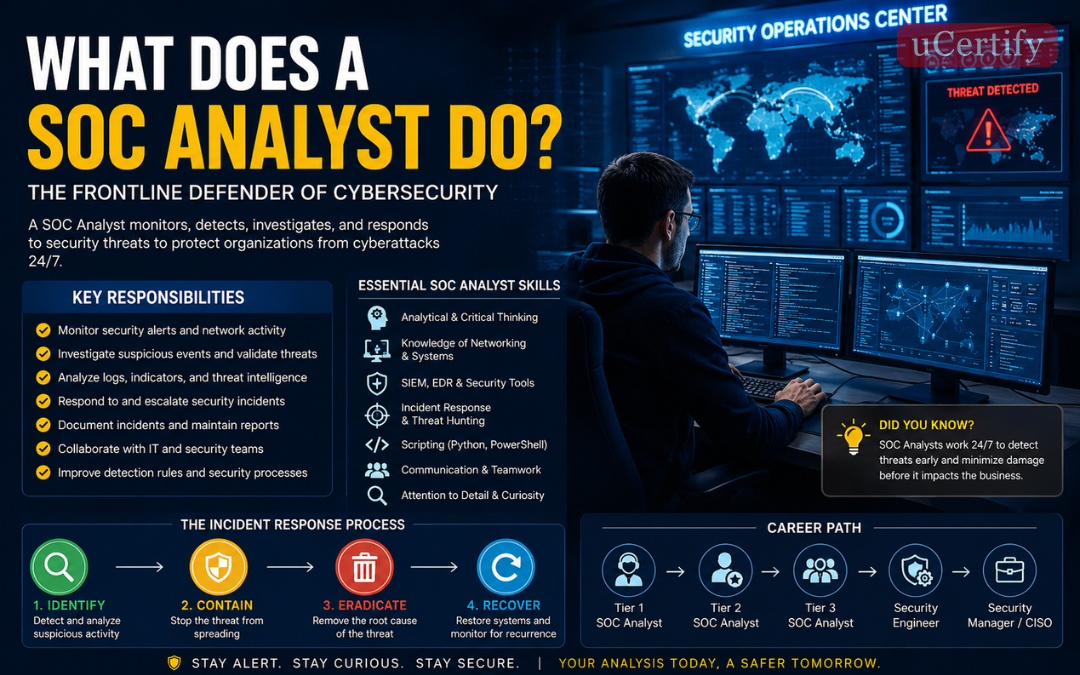
Understanding the Role of a SOC Analyst
Cyberattacks are no longer limited to large corporations or government agencies. Today, businesses of every size face threats such as phishing emails, ransomware, data breaches, and unauthorized access attempts. Because these attacks can happen at any time, organizations need professionals who can continuously monitor their digital environment and respond before a minor security issue becomes a major incident. That responsibility belongs to a SOC Analyst.
A Security Operations Center (SOC) is a centralized team responsible for monitoring and protecting an organization’s IT infrastructure. Within that team, SOC analysts play a key role in detecting, investigating, and responding to potential security threats. Instead of waiting for an attack to cause damage, SOC analysts actively monitor networks, investigate suspicious activity, and coordinate responses whenever security risks are detected.
If you’re considering a career in cybersecurity or simply want to understand how organizations defend themselves against modern threats, this guide will explain the daily responsibilities of a SOC analyst, the technical and soft skills required for the role, common security tools, career opportunities, and practical steps to get started.
Why Organizations Need a Security Operations Center
Many people assume that installing antivirus software or a firewall is enough to protect a business. In reality, cybersecurity is much more complex. Attackers constantly develop new techniques to bypass traditional security controls, which means organizations need continuous monitoring rather than one-time protection.
Many Security Operations Centers operate around the clock, either through internal teams, outsourced providers, or a combination of both, collecting security information from servers, cloud platforms, applications, endpoints, and network devices. The goal is to detect unusual behavior as early as possible. Instead of reacting after a system has already been compromised, the SOC works proactively by identifying warning signs that may indicate an ongoing attack.
Think of a SOC as the security control room of an organization. Just as airport security personnel monitor cameras and investigate suspicious activity before an incident escalates, SOC analysts watch over digital systems, looking for anything that appears abnormal. This proactive approach significantly reduces the risk of financial loss, operational downtime, and data theft. This business value is increasingly recognized across industries, particularly in risk management and insurance. As Sam Meenasian, Operations Director at USA Business Insurance, explains: From a business and risk management perspective, a dedicated SOC analyst is no longer just an IT expense; they are a critical risk mitigation asset. Organizations that can demonstrate proactive, continuous threat monitoring and rapid incident response not only protect their bottom line from devastating operational downtime, but also position themselves much more favorably when negotiating cyber insurance premiums and coverage terms.
What Does a SOC Analyst Do Every Day?
Although every organization has different security requirements, the daily work of a SOC Analyst generally follows a structured process. Their job extends far beyond watching dashboards filled with alerts. Each day involves analyzing data, investigating suspicious events, documenting findings, and working with other IT teams to protect business operations.
A typical day often begins by reviewing security alerts generated overnight. These alerts may come from login attempts, firewall events, antivirus software, cloud services, or employee devices. Since hundreds or even thousands of alerts can appear in a single day, one of the most important Cybersecurity Analyst Responsibilities is separating genuine threats from harmless system activity.
Once an alert is identified as suspicious, the analyst investigates its source. They examine system logs, compare user behavior with historical activity, review threat intelligence databases, and determine whether the event represents an actual security incident. If the threat is confirmed, they follow the organization’s incident response procedures to contain the issue and prevent it from spreading.
In addition to responding to alerts, SOC analysts regularly perform routine security tasks such as updating detection rules, documenting investigations, reviewing vulnerability reports, collaborating with system administrators, and preparing reports that help management understand the organization’s overall security posture.
A Real-World Example of a SOC Investigation
Understanding the role becomes much easier when viewed through a practical example.
Imagine an employee receives what appears to be an email from the company’s finance department requesting an urgent password reset. The employee clicks the link and unknowingly enters their login credentials into a fake website created by attackers.
Within minutes, the organization’s Security Information and Event Management (SIEM) platform detects something unusual. It notices that the employee’s account has logged in from two different countries within a very short period—an event commonly known as “impossible travel.” The organization’s security monitoring or identity platform detects an unusual sign-in pattern and generates an alert for the SOC team to investigate.
A SOC Analyst immediately begins the investigation. First, they review authentication logs to verify the login locations and timestamps. Next, they check whether the user’s account has attempted to access sensitive systems or download confidential files. Threat intelligence sources are consulted to determine whether the suspicious IP address has been associated with previous cyberattacks.
After determining that the activity is consistent with account compromise, the analyst temporarily disables the compromised account, forces a password reset, and blocks the attacker’s IP address through the organization’s firewall. They then notify the employee, document every action taken, and recommend additional security awareness training to reduce the likelihood of similar incidents in the future.
This example illustrates that a SOC analyst does far more than monitor alerts. They investigate evidence, make informed decisions under pressure, coordinate with multiple teams, and help prevent small incidents from developing into costly security breaches.
Heading Of The CTA
_(3)_0012Pw.webp)
Modern Security Operations Center
Defend, detect, and dominate–learn to build a Security Operations Center strong enough to outsmart any threat.
Learn MoreEssential SOC Analyst Skills
Developing strong SOC Analyst Skills requires a combination of technical expertise, analytical thinking, and effective communication. While security tools generate alerts automatically, interpreting those alerts and deciding how to respond depends on human judgment.
A solid understanding of networking fundamentals is essential because many attacks target network communications. Analysts should also understand operating systems such as Windows and Linux, since investigating security incidents often involves examining system logs, user permissions, and running processes.
Knowledge of cybersecurity technologies—including firewalls, intrusion detection systems, endpoint protection platforms, and cloud security services—is equally important. Familiarity with scripting languages such as Python or PowerShell can save valuable time by automating repetitive investigations and generating custom security reports.
Technical knowledge alone, however, is not enough. Successful SOC analysts are naturally curious and detail-oriented. They enjoy solving complex problems, remain calm during high-pressure incidents, and communicate clearly with colleagues who may not have a technical background. These soft skills often make the difference between an average analyst and an exceptional one.
Common Security Tools Used by SOC Analysts
Technology is at the heart of modern security operations, but tools are only as effective as the people using them. Depending on the organization, SOC analysts may work with multiple security platforms, each designed to answer a specific question: Has something unusual happened? Where did it happen? How serious is it? What should we do next?
One of the most important tools is a Security Information and Event Management (SIEM) platform. A SIEM collects logs from servers, firewalls, cloud services, applications, and employee devices, then brings all that information into one dashboard. Instead of checking dozens of systems individually, analysts can investigate security events from a single location. If someone attempts repeated failed logins, accesses sensitive files at an unusual hour, or connects from an unfamiliar location, the SIEM highlights that activity for review.
Another essential technology is Endpoint Detection and Response (EDR). While a SIEM focuses on collecting security events across an organization, an EDR monitors individual devices such as laptops, desktops, and servers. If malware begins encrypting files or an unknown program tries to disable antivirus software, the EDR can detect the behavior and, in many cases, isolate the affected device before the threat spreads to the rest of the network.
SOC analysts also rely on threat intelligence platforms, which provide information about newly discovered malware, malicious IP addresses, phishing campaigns, and attacker techniques. Rather than investigating every alert from scratch, analysts compare suspicious activity with known threat data to determine whether an incident is part of a larger cyberattack.
Many organizations now use Security Orchestration, Automation, and Response (SOAR) solutions as well. SOAR platforms use predefined playbooks to automate or coordinate repetitive response tasks, such as gathering evidence, notifying stakeholders, or initiating approved blocking actions. Automation allows analysts to spend less time on routine work and more time investigating complex threats that require human judgment.
Understanding the Incident Response Process
The incident response process varies by organization and framework, but it commonly includes preparation, detection and analysis, containment, eradication, recovery, and post-incident activities. A SOC analyst is often heavily involved in detection and analysis and may support containment and recovery activities.
The first stage is identification, where analysts confirm whether an alert represents a genuine threat or a false positive. False positives are common because automated systems sometimes flag legitimate user activity as suspicious. Careful investigation prevents unnecessary disruptions while ensuring real attacks receive immediate attention.
Once an incident has been confirmed, the next step is containment. The priority here is to stop the attack from spreading. Depending on the situation, this might involve disabling a compromised user account, disconnecting an infected computer from the network, or blocking malicious traffic through a firewall.
After containment comes eradication, where analysts remove the root cause of the incident. Malware is deleted, security vulnerabilities are patched, compromised credentials are reset, and unauthorized software is removed from affected systems.
The final stage is recovery. Systems are safely returned to normal operation, closely monitored for signs of recurring malicious activity, and documented in a detailed incident report. These reports are valuable because they help organizations improve future security controls and refine incident response procedures.
Working with Other Security Teams
Although a SOC Analyst often leads the initial investigation, cybersecurity is a collaborative effort. Security incidents frequently require input from network engineers, cloud administrators, system administrators, digital forensics specialists, and management teams.
For example, if ransomware affects a company’s file servers, the SOC analyst may identify the attack and isolate infected devices, while system administrators restore backups, network engineers block malicious traffic, and incident response specialists investigate how the attackers gained access. Clear communication between these teams reduces downtime and helps the organization recover more quickly.
SOC analysts also play an important role in educating employees. Many successful cyberattacks begin with simple human mistakes, such as clicking a phishing link or using weak passwords. By sharing lessons learned from previous incidents, analysts help strengthen the organization’s overall security culture.
SOC Analyst Career Path
One of the biggest advantages of choosing cybersecurity is the variety of career opportunities available. The SOC Analyst Career Path is well structured, allowing professionals to gradually develop technical expertise while taking on greater responsibility. Many SOCs organize analyst responsibilities into Tier 1, Tier 2, and Tier 3 levels, although titles and responsibilities vary between organizations.
Most professionals begin as Tier 1 SOC Analysts. At this level, the primary responsibility is monitoring alerts, reviewing system logs, identifying suspicious activity, and escalating confirmed incidents to senior team members. This stage provides valuable hands-on experience with security tools, log analysis, and incident documentation.
After gaining practical experience, many analysts advance to Tier 2 roles. Tier 2 analysts typically conduct deeper investigations and may perform threat hunting or malware analysis depending on the organization’s structure. They also mentor junior analysts and help improve detection rules within the SOC.
The highest operational level is typically Tier 3, where analysts specialize in advanced threat detection, digital forensics, malware reverse engineering, or proactive threat hunting. Tier 3 professionals often investigate sophisticated attacks carried out by organized cybercriminal groups or nation-state actors.
With experience and additional specialization, SOC professionals may move into roles such as security engineering, cloud security, incident response, threat intelligence, security architecture, or security leadership. Some may eventually progress into senior leadership roles such as CISO. This progression makes cybersecurity one of the most flexible and rewarding technology careers available today.
Certifications and Learning Roadmap
Education requirements vary by employer and region. A degree in cybersecurity, computer science, information technology, or a related field can be helpful, while practical experience, technical skills, and certifications may also strengthen a candidate’s profile.
Beginners should first develop a solid understanding of networking, operating systems, and basic cybersecurity concepts. Certifications such as CompTIA Security+ provide a strong foundation, while CompTIA CySA+, Certified Ethical Hacker (CEH), or GIAC Certified Incident Handler (GCIH) help build more specialized incident response skills.
Practical experience is equally important. Platforms like TryHackMe, Hack The Box, Blue Team Labs Online, and Microsoft Sentinel training environments allow learners to investigate realistic security scenarios in safe virtual environments. Creating a small home lab using virtual machines is another excellent way to practice log analysis, malware detection, and system monitoring without risking production systems.
Employers consistently value candidates who can demonstrate practical problem-solving skills. A portfolio containing investigation reports, SIEM dashboards, scripting projects, or documented lab exercises often leaves a stronger impression than certifications alone because it shows the ability to apply knowledge in realistic situations.
Common Challenges Faced by SOC Analysts
Working as a SOC Analyst is rewarding, but it also comes with challenges that require patience and continuous learning. One of the biggest difficulties is managing the large number of alerts generated every day. Enterprise security systems can produce thousands of notifications, and not every alert represents a real attack. Analysts must quickly determine which events deserve immediate attention and which are harmless. This process demands strong analytical thinking and careful attention to detail.
Another challenge is keeping pace with the rapidly changing cybersecurity landscape. Cybercriminals constantly develop new malware, ransomware variants, phishing techniques, and social engineering tactics. A detection rule that works today may become ineffective tomorrow. For this reason, SOC analysts spend time reading threat reports, attending security webinars, and practicing in lab environments to stay current with emerging threats.
The role can also be demanding during major security incidents. Investigations may continue for several hours while multiple teams work together to contain the attack. Although these situations can be stressful, they also provide valuable learning experiences and strengthen an analyst’s problem-solving abilities.
The Future of the SOC Analyst Role
As organizations move more applications and data to the cloud, the responsibilities of a SOC Analyst continue to evolve. Modern security teams now monitor hybrid environments that include on-premises servers, cloud platforms, remote employees, and Internet of Things (IoT) devices. This shift has increased the demand for professionals who understand cloud security, identity management, and zero-trust security models.
Artificial intelligence is also changing the way Security Operations Centers function. Many modern security platforms use machine learning to identify suspicious patterns and prioritize alerts. However, AI does not replace SOC analysts. Instead, it helps reduce repetitive work so analysts can focus on investigations that require human judgment, contextual understanding, and decision-making. Organizations will continue to rely on skilled professionals who can interpret security data, validate automated findings, and coordinate effective incident responses. This mirrors a broader shift across business functions, just as conversational AI is handling routine customer and employee interactions in sales, support, and HR, AI in the SOC is absorbing repetitive triage tasks so human analysts can focus where judgment matters most.
Because cyber threats continue to grow in both number and complexity, employment opportunities for SOC analysts are expected to remain strong for years to come. Professionals who combine technical expertise with communication skills and practical experience will be well positioned for long-term career growth.
Key Takeaways
Before pursuing this career, remember these important points:
- A SOC Analyst is responsible for monitoring, detecting, investigating, and responding to cybersecurity threats.
- Strong SOC Analyst Skills include networking, operating systems, log analysis, scripting, communication, and critical thinking.
- A typical investigation follows the stages of identification, containment, eradication, and recovery.
- Practical experience gained through labs and real-world projects is just as valuable as certifications.
- The SOC Analyst Career Path offers opportunities to progress into advanced cybersecurity roles such as Security Engineer, Threat Hunter, Security Architect, and CISO.
Frequently Asked Questions
Is a SOC Analyst a good career for beginners?
Yes. Many cybersecurity professionals begin their careers in a Security Operations Center because the role provides practical experience with monitoring tools, incident response, and security investigations. It builds a strong foundation for future specialization.
Do I need programming knowledge to become a SOC Analyst?
Programming is not mandatory for entry-level positions, but learning Python or PowerShell can help automate repetitive tasks, analyze logs more efficiently, and improve career prospects.
Which certifications are most valuable?
Beginners often start with CompTIA Security+, while professionals looking to specialize may pursue CompTIA CySA+, CEH, GCIH, or CISSP after gaining industry experience. The best certification depends on your career stage and long-term goals.
How long does it take to become a SOC Analyst?
There is no fixed timeline. Someone with basic IT knowledge who consistently practices networking, operating systems, security monitoring, and hands-on labs may become competitive for entry-level SOC roles within months, while others may need longer depending on their starting point and the requirements of employers. Building practical skills through home labs, Capture the Flag (CTF) exercises, and security platforms usually has a greater impact than simply passing certification exams.
Conclusion
A SOC Analyst plays a vital role in protecting organizations from constantly evolving cyber threats. From monitoring security alerts and investigating suspicious behavior to coordinating incident response and improving security processes, these professionals are an essential part of every modern Security Operations Center.
Success in this field requires more than technical knowledge. Curiosity, analytical thinking, clear communication, and a commitment to continuous learning are equally important. By developing strong SOC Analyst Skills, gaining hands-on experience with industry-standard tools, and following a structured SOC Analyst Career Path, aspiring professionals can build a rewarding career in one of the fastest-growing areas of information technology.
For anyone interested in cybersecurity, becoming a SOC analyst is more than just a job opportunity—it is an opportunity to solve challenging problems, protect critical digital assets, and contribute to the security of businesses and communities in an increasingly connected world.


_00193n.png)

_0017YB.png)
No Comments Yet
Be the first to share your thoughts on this post!